Plastering Calculator: Complete Guide to Cement, Sand & Mortar Estimation
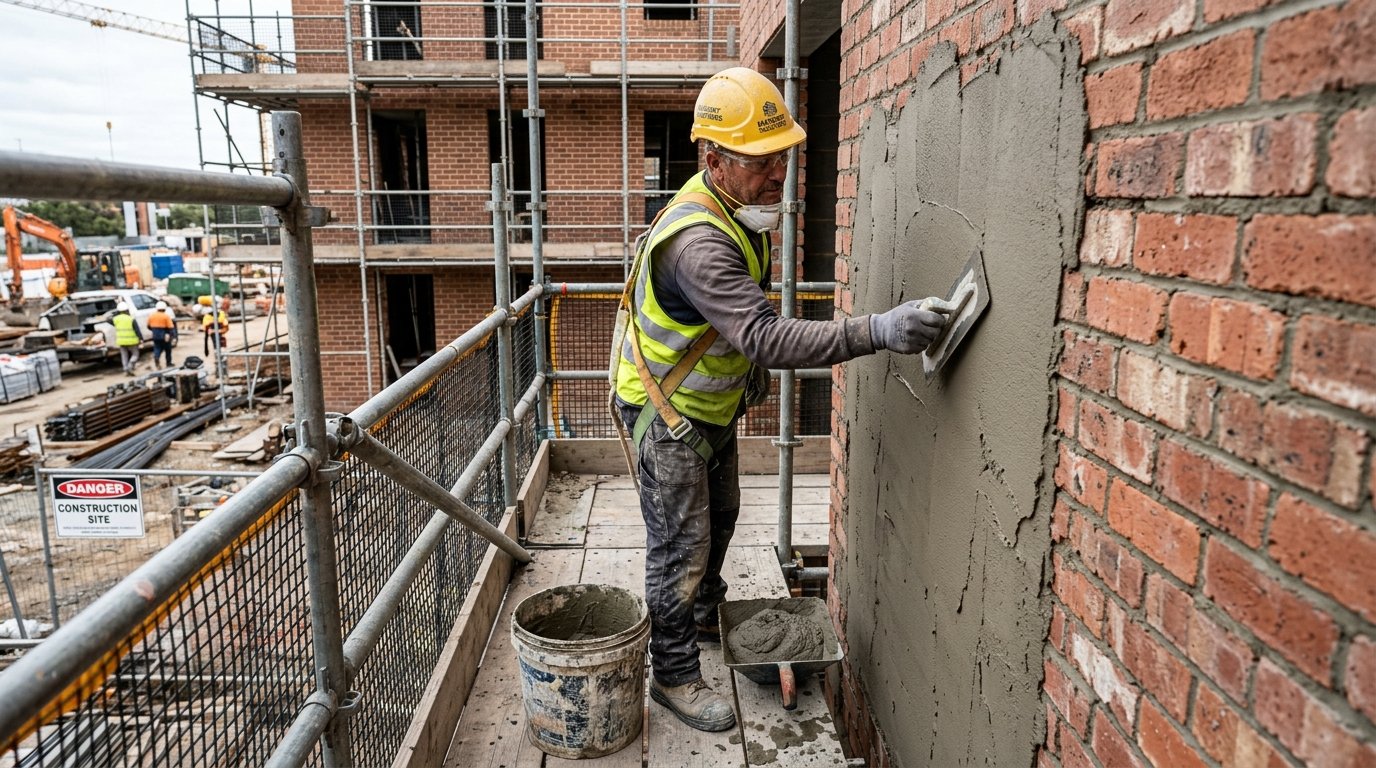
Plastering is the application of cement mortar over brick, block, or concrete surfaces to create a smooth, durable, and aesthetically finished wall or ceiling surface. Accurate plastering quantity estimation is essential for project budgeting, material procurement, and avoiding mid-project material shortages. This guide explains the complete engineering theory, mortar ratio science, dry-to-wet volume conversion, and IS code specifications for plastering work.
1. What is Plastering and Why Does it Matter?
Plastering serves multiple engineering functions in building construction: (a) Protection — shields masonry and concrete from weather, moisture, and mechanical damage; (b) Finishing — provides the base surface for paint, tiles, or wallpaper; (c) Fire resistance — adds a protective layer that slows heat transfer to structural members; (d) Sound insulation — adds mass to walls improving airborne sound transmission loss; (e) Waterproofing — when done with waterproof additives (e.g., Cico, Sika, Dr. Fixit integral compounds), protects basements and wet areas.
2. Mortar Ratios: The Engineering Science
Cement mortar for plastering is specified as a volumetric ratio of cement : sand. The ratio determines strength, workability, and surface finish quality:
| Mix Ratio | Application | Compressive Strength |
|---|
| 1:3 (1 cement : 3 sand) | Ceiling plaster, waterproof plaster, RCC surfaces | High (~10 N/mm²) |
| 1:4 (1 cement : 4 sand) | Internal walls, first coat (rendering coat) | Medium (~7 N/mm²) |
| 1:6 (1 cement : 6 sand) | Brick masonry external plaster, second coat | Lower (~4 N/mm²) |
A richer mix (more cement) gives higher strength and lower permeability but is more prone to shrinkage cracking. A leaner mix (more sand) is more workable and cheaper but weaker and more porous.
3. Dry Volume vs Wet Volume: The Key Concept
This is the most critical and commonly misunderstood concept in mortar calculation. When cement and sand are mixed dry, they occupy a certain volume. When water is added, the mix compacts (voids are filled) and the volume reduces by approximately 30–35%. Therefore, to get 1 cubic metre of wet (placed) mortar, you need approximately 1.3 to 1.35 cubic metres of dry materials.
Dry Volume = Wet Volume × 1.3 (commonly used factor)
For 1:6 mortar (1 part cement + 6 parts sand = 7 total parts):
- Volume of cement = (1/7) × Dry Volume
- Volume of sand = (6/7) × Dry Volume
- Number of cement bags = Volume of cement ÷ 0.0347 m³ (volume of one 50 kg bag)
4. Plastering Thickness Standards (IS 1661)
IS 1661: Code of Practice for Application of Cement and Cement-Lime Plaster Finishes specifies standard thickness for different applications:
- Internal wall plaster (brick): 12 mm in single coat
- External wall plaster: 20 mm in two coats (12 mm base + 8 mm finish)
- Ceiling plaster (RCC): 6 mm (bonding coat) to 12 mm
- Waterproof plaster (basements, bathrooms): 20–25 mm with integral waterproofing compound
- Gypsum plaster (internal finishing coat): 10–13 mm
5. Types of Plaster
Cement Plaster: Most common; durable, strong, moisture-resistant. Requires curing for 7–14 days after application.
Lime Plaster: Traditional; more flexible (accommodates minor movement), breathable, suitable for heritage buildings and hot-dry climates. Takes longer to set.
Gypsum Plaster: Ready-made powder; sets quickly (2–3 hours); excellent smooth finish; used only for interior applications (not weather resistant). Eliminates need for wall putty.
POP (Plaster of Paris): Used for false ceilings, cornices, and decorative mouldings. Very smooth finish; not suitable for wet areas.
6. Common Plastering Defects
Cracking: Most common defect. Causes: excessive cement (rich mix), inadequate curing, rapid drying in hot weather, or structural movement in the supporting wall. Remedy: Use appropriate mix ratio, cure properly, apply control joints at regular intervals (3–4 metre spacing).
Efflorescence: White salt deposits appearing on the surface. Cause: soluble salts in bricks or sand migrating to the surface with moisture. Remedy: Use washed river sand, treat bricks with waterproof primer before plastering.
Hollow Plaster (Debonding): Plaster separates from background. Cause: surface not properly keyed (roughened), too smooth concrete or brick surface, or plaster applied too thickly in one coat. Remedy: Hack the surface, apply bonding agent before plastering.
7. Sample Calculation: 100 sqm Internal Wall (1:6 Mortar, 12mm Thick)
- Wet Volume of mortar = 100 m² × 0.012 m = 1.2 m³
- Dry Volume = 1.2 × 1.3 = 1.56 m³
- Cement volume = (1/7) × 1.56 = 0.223 m³ = 0.223/0.0347 = 6.4 bags (50kg)
- Sand volume = (6/7) × 1.56 = 1.337 m³ ≈ 1.34 m³ of sand
Add 10% wastage: Cement = 7 bags; Sand = 1.48 m³ ≈ 1.5 m³
8. Frequently Asked Questions
Q1: How long does plaster take to dry?
Cement plaster takes 24–48 hours to dry enough to touch, but requires 28 days of curing (wet curing or membrane curing) to achieve full strength. Gypsum plaster dries in 2–4 hours.
Q2: What is the IS code for plastering?
IS 1661:1972 covers application of cement and cement-lime plaster finishes. IS 2394 covers application of lime plaster finishes. IS 2402 covers external rendered finishes.
Q3: Can I plaster directly on concrete?
Concrete surfaces need to be roughened (hacked with a chisel or scabbler) or a bonding agent applied before plastering, as smooth concrete has poor mechanical bond for mortar adhesion.
Q4: What is gypsum plaster and when should I use it?
Gypsum plaster (e.g., USG, Gyproc, Lafarge brands) is used for internal finishing coats. It gives an extremely smooth surface, sets quickly, and eliminates the need for wall putty. Not suitable for external use, bathrooms, or kitchens.
Q5: How many bags of cement per square metre of plastering?
For 12mm thick 1:6 mix: approximately 0.064 bags/sqm. For 20mm thick 1:4 mix: approximately 0.16 bags/sqm. Always add 5–10% wastage.
Q6: What sand should be used for plastering?
Use clean, washed river sand or M-sand (manufactured sand) conforming to IS 2116. Avoid salty beach sand or oversize aggregate. Sand FM (Fineness Modulus) of 1.2–2.2 is ideal for plastering mortar.
Q7: How do I prevent plaster from cracking?
Use the correct mix ratio, avoid very rich cement mixes, cure properly for 7 days minimum, avoid plastering in very hot or windy conditions, use fibre-reinforced mortar additives, and provide control joints for large wall areas.
Q8: Is external plaster different from internal plaster?
Yes. External plaster uses richer or more durable mixes (1:4 base coat + waterproof finish coat), is applied in two layers totaling 20mm, and must withstand rain, UV, and temperature cycling. Internal plaster is typically 12mm single coat in 1:6 mix.
Q9: What is the life expectancy of cement plaster?
Properly applied cement plaster on a stable background can last 20–30 years or more. External plaster in harsh climates may need repair or re-coating every 8–15 years depending on exposure and paint protection.
Q10: Can I add waterproofing to plastering mix?
Yes. Integral waterproofing compounds (liquid or powder) are added to the mortar mix (typically 2% of cement weight) for bathrooms, water tanks, basements, and external plaster in heavy rainfall areas. Products include Cico, Dr. Fixit Pidicrete, and Fosroc Renderoc.